 Henry Ho
Holographic Display : Part 1
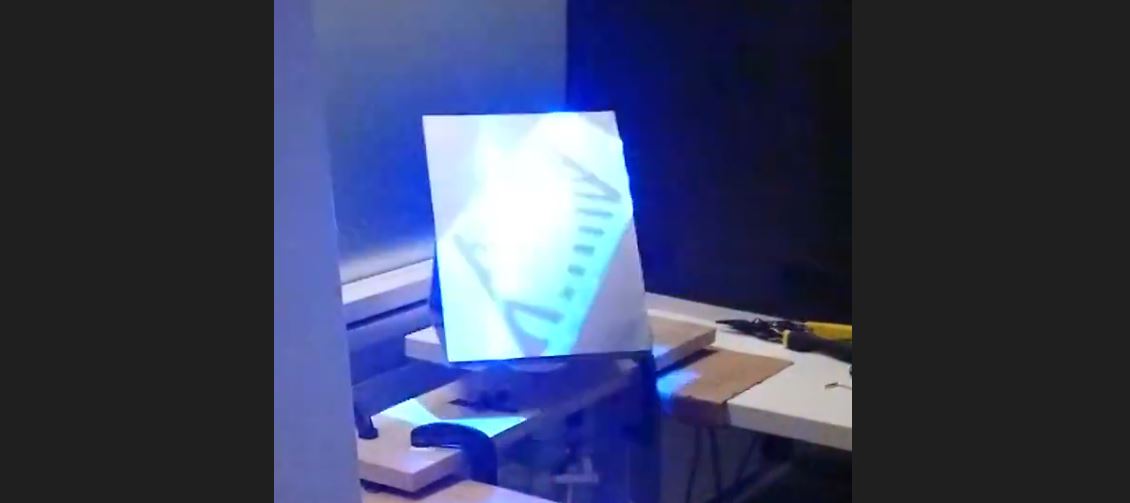
This was my first attempt at implementing a spinning lightfield display to create the illusion of a floating hologram for the purposes of displaying a digital assistant at CES.
I used a brushed aluminum sheet for the anisotropic mirror that was to be spun to deliver slices of images in 360 degrees. I drove the spin with a cheap fan motor and used our office’s conference room projector (mounted above and pointed down at the spinning mirror display).
I synchronized the rotation of the spinning display with the projector by using a Raspberry Pi that had a light sensor pointed up at a small mirror mounted on the underside of the display. The small mirror reflected light from a $5 pocket laser every time it reached a certain angle during its rotation. The Raspberry Pi would take readings of when the laser hit the mirror and send them to my Unity 3D program, which would then be able to detect the spin rate of the fan motor, and predicatively send properly rotated image to the projector.
Unfortunately this method was going to require a much more precise and higher refresh rate projector and much more precise servo motor than our budget allowed, so it was abandoned for Part 2, which did succeed.
Furthermore, this jerry-rigged system was all sorts of dangerous, as the projector’s light rays are dangerous to look at directly, and the metal sheet was spinning at over 20 rotations per second. It was however, quite a spectacle around the research office.
I took these with my Sony XZ1 Compact that could record ultra-slow 960 fps video to debug the issues we were facing with synchronization and image splitting from the projector.
The projector was also not going to cut it, because it composited images with 3 images (Red, Green, and Blue images), which meant that its refresh rate was actually a third of what was advertised, it would never have high enough of a refresh rate to deliver enough images per second
This was what I was trying to recreate. I was fascinated and obsessed with it and dug up all the research publications they released about it. Most of it was here.
It was created by USC’s Institute of Creative Technologies. Their results are much more impressive than mine 🙂
In my defense, this was my first foray into physical engineering, I had a much lower budget (I used a $15 fan motor to spin the display), and I had no idea what I was doing (I was not a display researcher by any measure prior to this experiment).
It took about a month to figure out that I wasn’t going to be able to recreate this without some serious expertise in embedded systems programming and much higher grade equipment. The modified projector that they were using utilized a custom programmed FPGA-based circuitry to drive the DLP projector, encoding 24 frames of binary image data into each color frame. My cheap fan motor didn’t have enough consistency and accuracy, as I realized when did more research on servo motors and induction motors. The induction motor had varying spin rates and its speed fluctuated greatly even over the course of a single rotation due to how it is propelled. There was no way that my predictive synchronization method would work in this scenario.